If you are searching for an NVivo alternative, you are probably already familiar with the name and weighing up whether it is still the right choice for your qualitative research work. NVivo is recognised across both industry and academia, and for many teams it has been the default tool for analysis of qualitative research. The question is, does it still support qualitative research now, as AI evolves and the industry demands more from qualitative teams?
Established tools do not always mean best fit, and research environments shift over time. Teams have become more distributed, and clients expect clearer links between raw data and final outputs. For internal stakeholders, they seek out transparency, speed and cost effectiveness. All of this puts pressure on software, even when it’s been the accepted default for many years.
There has also been a significant shift in expectations, where manual coding was once seen as the gold standard because automation was viewed with suspicion; clients are now far less willing to fund days of human coding when secure, high-trust platforms can deliver structured outputs quickly and still make their workings visible.
What is NVivo?
SOURCE: https://www.statcon.de/
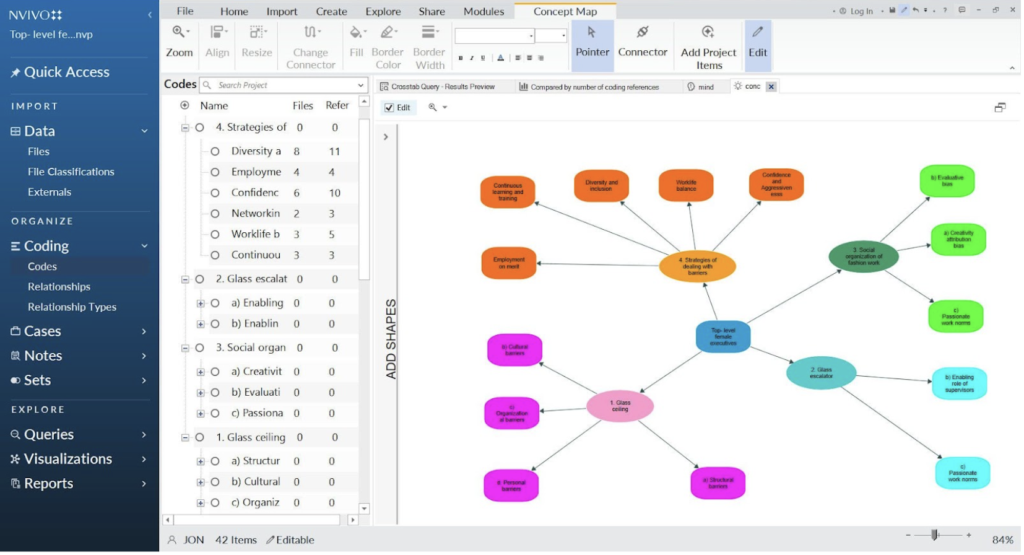
NVivo is a qualitative data analysis software platform designed to help researchers organise, code and analyse unstructured data. It has been used both with academic research, as well as market and industry-based projects, government and healthcare. It can manage interviews, focus groups, surveys, social media content and other text, audio and mixed media sources.
It was originally developed in the late 1990s by QSR International in Australia. Currently, NVivo is owned by Lumivero, after the parent company merged with Palisade in 2023.
It is a desktop-based tool that includes features such as:
- Manual coding with a hierarchical code structure, known as nodes
- Support for text, PDF, audio, video and survey data
- Query tools to explore word frequency, coding intersections and patterns
- Case classification for organising participants or groups
- Visualisation including charts, models and concept maps
- Exportable reports to support audit trails and stakeholder reporting.
It allows researchers to run qualitative workflows with tight control over how data is coded and interrogated.
Who uses NVivo?
Many of NVivo’s users are postgraduate researchers, PhD candidates and academic teams, as well as structured qualitative research units across a wide range of disciplines. It’s typically used by researchers who require formal methodology and audit trails.
In discussions on Reddit, many users describe fairly traditional workflows built around manual coding. As one user put it:
“Basically you will see a wall of text (in your case tweets) where you find similar ideas or thoughts that are expressed in writing, and basically highlight them. You will start to create bins or groupings of ideas across the datasets which you label and name yourself.”
On another thread, one user summarised their usage more simply:
“I haven’t used it strictly for thematic analysis but I do use it for my lit reviews (in which I am coding sections of articles for concepts I would like to cover in a paper) and content analysis.”
Why do people look for alternatives to NVivo?
For many searching for an NVivo alternative, there is often a case where friction with the tool outweighs habit. The drawbacks fall into some distinct categories:
1. Cost of NVivo
The cost of NVivo is tiered, and there are some cheaper entry points with educational discounts, student pricing and academic packages. However, if you are in need of a commercial license, this can get more expensive. As of 2026, NVivo licenses start at around $1,249 per annual license for a standard version. The price can vary depending on the region and if discounts are given for larger teams. For a small team of 10, this can cost in excess of $10,000 before any work has been completed.
2. Steep learning curve
The interface is dense and full of many tools that can feel overwhelming at first. It requires a lot of knowledge on how nodes work, how to build coding hierarchies, and the manual classification of data. It requires time and practice which many teams do not necessarily have the flexibility to undertake. In one review on G2, a user states:
“While NVivo is powerful, it does have a steep learning curve; it takes time to get used to its interface and fully leverage its wide range of features.”
3. Manual, time-intensive coding
NVivo is built around manual coding. Researchers create codes, organise them into hierarchies then go through the transcripts line by line, assigning segments of text to these codes. On a small project, this can be manageable, but when the study is larger this can require a lot of manual work. With AI more generally used now, manual coding, while still useful, can cause friction and take too much time away from the analysis of the work.
4. Desktop-based workflow
NVivo is primarily designed as a desktop application. Researchers install the software locally and work within a project file saved to their machine or a shared drive. Collaboration is possible, but it often relies on structured file management, version control, or additional cloud components. Managing access, syncing files and avoiding version clashes can take time away from the research itself, particularly when compared with browser-based platforms built for real-time collaboration.
Local installation has historically been important for highly sensitive government or scientific datasets, where organisations required full control over infrastructure, yet some newer qualitative platforms now offer locally hosted, off-cloud deployments that provide the same protected environment without losing the usability and collaboration benefits associated with modern systems.
5. Over-engineered for small projects
NVivo is designed to handle complex, large-scale qualitative studies with layered coding structures, classifications and advanced queries. For small projects, such as a handful of interviews or a short-term insight sprint, that level of structure can feel excessive. Setting up nodes, cases and project frameworks takes time, and the interface does not simplify just because the dataset is small.
Alternatives to NVivo for qualitative data coding
If your team is reassessing whether NVivo still fits your workflow or budget, or you are looking for your first qualitative research tool, there are several credible alternatives to NVivo that can be considered.
1. Beings
Beings is a modern alternative to traditional manual coding environments. Rather than requiring researchers to build complex node categories and sift through data line by line, Beings applies AI-driven analysis to videos, transcripts and other data sources. Themes and proof points are surfaced automatically, with every insight linked back to the original source.
The core difference between Beings and NVivo is workflow. There is no need to spend hours structuring a project before analysis can begin. Teams can upload videos and transcripts to Beings and start exploring immediately. The platform clusters responses, identifies emerging themes, and groups sentiment without requiring manual tagging as the starting point. Researchers can still interrogate the data, refine categories and validate findings, but they are not responsible for building the entire coding architecture from scratch.
Beings is built around what it calls the Ground Truth principle. Every quote, claim, thought or insight remains traceable to the original participant’s response. Speed can be fast, but not at the expense of transparency. This means that commercial teams working to deadlines can proceed quickly, analyse thoroughly but have an auditable project that can face scrutiny. It also supports clear data sovereignty standards, giving organisations confidence over where their data is stored, how it is processed and who retains control of it.
2. ChatGPT

ChatGPT can, theoretically, be used for qualitative data analysis and many researchers have experimented with summarising transcripts and drafting early interpretations with it. As a tool it is fast and easy to access. That said, it is a general-purpose language model and NOT a dedicated qualitative research platform. It does not provide a built-in project structure, coding hierarchies, options for audit trails or clear structured traceability between insight and source data, it is also known for hallucinations in data, which can be incredibly difficult to spot when dealing with large datasets.
In addition to this is the subject of data governance. Unless you are operating in a secure enterprise environment with clear contractual terms, pasting sensitive research data into a generalist AI tool may raise concerns around data handling, storage and compliance. For many research teams working with client data, personally identifiable information, or within regulated industries, this is key.
ChatGPT can be useful as a supporting tool for exploration or drafting, but when working in structured qualitative research, most teams require something more purpose-built. Find out more in our Beings vs ChatGPT article to discover the differences in more detail.
3. Dedoose
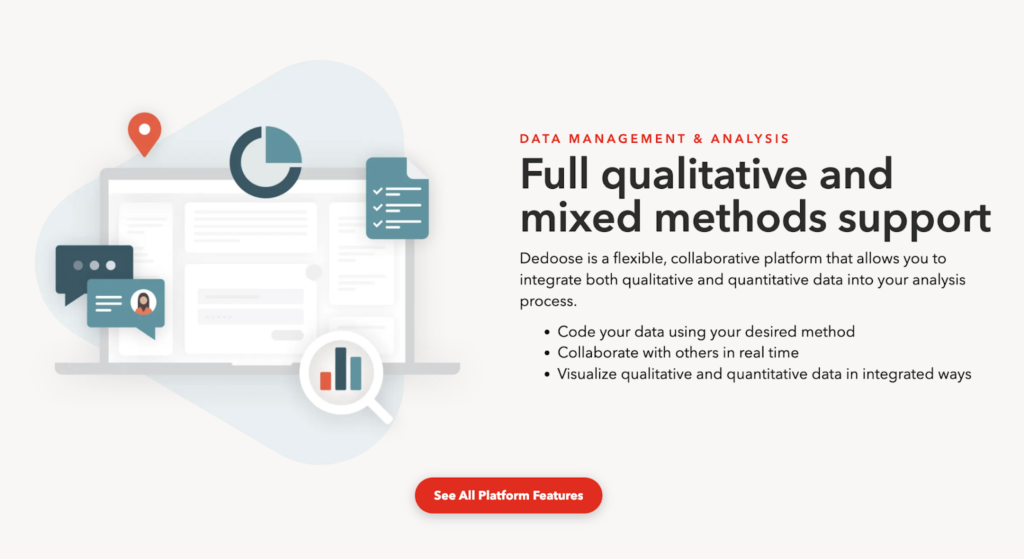
Dedoose is a web-based qualitative research and mixed methods analysis platform designed for academic and applied research settings. It’s run through a browser, making it easier for distributed teams who need shared access without installing software locally.
As a tool, it supports text, audio and video coding, and offers features to allow researchers to link qualitative codes to quantitative descriptors. Researchers are able to build code trees, apply code to excerpts and run basic analyses to explore data. The cost is also far lower than NVivo with small teams able to gain access to the tool for around $15.95 per user per month for between 2-5 users.
That said, Dedoose still relies on manual coding as the foundation of analysis. Researchers need to create and apply codes themselves, and Dedoose is almost a lighter version of NVivo in that respect. If your team is seeking for more automation or AI-assisted theme generation, it will (as of 2026) currently lack that functionality.
How to choose the right NVivo alternative
Choosing the right NVivo alternative comes down to how your team actually works and what it needs from a qualitative research perspective.
If your projects are highly academic and require deep manual coding structures, then a traditional coding platform may suit you. If you need a collaborative environment, a lighter setup or subscription flexibility, then browser-based tools might be more appropriate. For cost-effectiveness, speed and automation capabilities are key, then an AI-led platform will likely be the direction you need to go.
Ask yourself:
- How much time are we currently spending on manual coding versus analysis?
- Do we need rigid coding hierarchies, or do we need faster theme surfacing?
- How important are collaboration and real-time access?
- What level of auditability and data sovereignty is required for our clients?
For commercial research teams that require detailed insight, transparency and auditable workflows that are easy to access, Beings offers a materially different approach to NVivo. It reduces manual workload, automates much of the time-consuming elements and keeps every insight grounded in the original participant responses, all while adhering to strict data governance.
If you want to see how AI-driven qualitative analysis feels in practice, you can try Beings for free and test it against your current workflow before committing to a switch.
FAQs about NVivo
1. What is NVivo used for?
NVivo is used to organise, code and analyse qualitative data such as interviews, focus groups, open ended survey responses, documents and multimedia files. Researchers use it to apply codes to text, group themes into hierarchies and run queries to explore patterns across datasets. It is designed to support structured qualitative workflows and maintain a clear audit trail from raw data to reported findings.
2. Is NVivo only for academic research?
No. NVivo is widely used in universities, but it is also adopted by government departments, healthcare organisations and commercial research teams. That said, its pricing structure and traditional coding workflow often make it more common in academic environments where institutional licences are available and projects follow established methodological frameworks.
3. Is NVivo difficult to learn?
NVivo is powerful but not always intuitive for beginners. The interface includes multiple panels, coding structures, classifications and query tools, which can feel dense at first. Many users require formal training or guided onboarding before they feel confident using its full functionality. For experienced qualitative researchers, the structure can be valuable, but there is a noticeable learning curve.
4. What are the main alternatives to NVivo?
Common alternatives include Dedoose, which offers a browser-based manual coding environment, and ChatGPT, which some researchers use for exploratory theme identification, although it is not purpose-built for structured qualitative analysis. AI-driven platforms such as Beings AI take a different approach by automating theme surfacing and linking insights directly back to source material, reducing the need for fully manual coding workflows.