Customer research recordings need fast, accurate transcription that meets compliance and data-privacy requirements. This is because customer research recordings often carry detailed accounts of behaviour, expectations and unmet needs. Equally, researchers usually want to move into early analysis as quickly as possible while the information is fresh in their mind.
When recordings start to pass through free tools, public platforms or mixed storage locations, many questions are raised about the control and privacy of that data.. Consumer-grade AI tools such as ChatGPT, increasingly used by junior and senior researchers, aren’t able to guarantee data security and client confidentiality. What most don’t realise is that ChatGPT is ran on U.S. servers, which means that any information that passes through is sent to the U.S. for analysis. For many UK and European research terms, this isn’t compliant with client requirements.
Qualitative researchers need secure transcription software that keeps every file inside a protected workspace so the transcript, the coding and the first round of interpretation all happen in one contained environment.
Beings provides this workflow by keeping all research recordings inside a private, encrypted system. Beings gives researchers the ability to select the servers they use for their workspaces by choosing the AI model. Whether this is restricted to UK only servers, or whether other servers (like U.S. or European) are allowed, which then broadens which AI models can be used on projects.
Beings removes the need for public transcription tools and gives researchers a predictable way to securely transcribe customer recordings.
Why secure transcription matters in customer research
Customer research relies on material that needs careful management, yet the practical work of organising recordings and transcripts tends to fall to researchers themselves. Many organisations, including research teams, are now dealing with the rise of Shadow AI, where staff turn to public AI tools without approval because they feel pressed for time or lack dedicated support. This pattern has been highlighted repeatedly in recent industry reports that indicate how researchers and knowledge workers are uploading material to consumer platforms that store prompts, retain data or use shared models.
Customer research recordings often contain operational details, personal information and commercially sensitive content, which means that this action carries risk. A secure transcription platform like Beings keeps the material inside a controlled environment, limits unnecessary transfers and protects both participants and clients from exposure created by unapproved tools.Many who turn to these unofficial transcription tools find that, in the moment, a single query seems harmless. The task often feels small and self-contained, yet the recording becomes part of a system that the organisation does not control, and the researcher cannot audit, which is why secure handling needs to begin at the point of upload. This highlights why data security in transcription needs to be built into the workflow rather than addressed later.
Are consumer and free transcription tools secure?
Consumer AI platforms, including tools such as ChatGPT or Microsoft services, and other free transcription tools do not have client security or data sovereignty built-in. These systems often run on broad models that process many forms of user data, yet they provide limited visibility on retention, internal access or how files are handled once uploaded.
A recent development in the New York Times litigation against OpenAI showed how user data in large consumer platforms can fall under legal preservation requirements. For several months, OpenAI was required to retain consumer ChatGPT and API content under a court-ordered preservation requirement, including material that users believed would be temporary. Although the order later changed and the company returned to its standard thirty-day deletion policy, the case shows that material stored in consumer platforms can, at times, be held for reasons outside the user’s control.
The details of that case are specific to a legal dispute, but the principle applies more widely. Even trusted consumer tools may sit outside an organisation’s compliance framework, and most researchers would avoid placing identifiable customer data into any environment without clear information on retention or access. Transcription should follow the same standard.
With Beings, when its AI analyses a document, it processes the text to extract insight and then effectively “resets.” There is no feedback loop sending client data back to a central “brain” to update the model weights. The AI engine is static, where improvements come from upgrading the underlying engineering code, not from digesting client data.
How AI supports transcription in modern research
The move from a raw recording to workable material in custom research involves several stages that benefit from automated support. AI now plays a practical role in preparing recordings and transcriptions for analysis because the speed required in modern research makes manual transcription difficult to sustain. Automated support now helps generate accurate transcripts, surface repeated ideas and gives researchers a way to move quickly into interpretation.
These gains do not replace the need for human review or decision-making, yet they provide structural support that would be hard to replicate within typical project timelines without automated assistance. AI needs to be included in a way that is aligned with customer research workflows and adheres to governance and compliance requirements.
How Beings provides a secure transcription tool for customer research recordings
Beings keeps every recording inside a private, encrypted workspace from the moment it enters the system, so the full transcription and analysis process remains contained. Researchers can account for where the data sits, who can access it and how it moves through the workflow.
Key safeguards of the system include:
- Private, encrypted storage that keeps audio files, transcripts and notes inside the project level repository
- Multi-corpus architecture that separates user, project and organisation knowledge so client material stays in the correct context, with no cross-client contamination
- SOC II, GDPR and HIPAA aligned controls that govern storage, access and handling
- No sending of data to public models and no use of customer recordings for generic training. Beings utilises frozen, pre-trained foundational models. Unlike “live” consumer AI tools, the models don’t learn continuously from user inputs. The system uses a Retrieval-Augmented Generation (RAG) and Knowledge Graph architecture, strictly forcing the AI to look only at the specific evidence provided for the project.
- A workspace that replaces ungoverned uploads with a predictable, auditable flow
This gives researchers a security framework they can describe clearly to clients and internal teams when using Beings to securely transcribe research recordings
How to transcribe customer research recordings securely with Beings
Once customer recordings are uploaded to Beings, the full transcription and analysis workflow takes place in a private, encrypted workspace. Giving researchers a clear route to using secure transcription software without relying on public tools or consumer platforms.
The steps to do this are straightforward, and each stage keeps the material within the project-level repository, so nothing moves through unapproved systems.
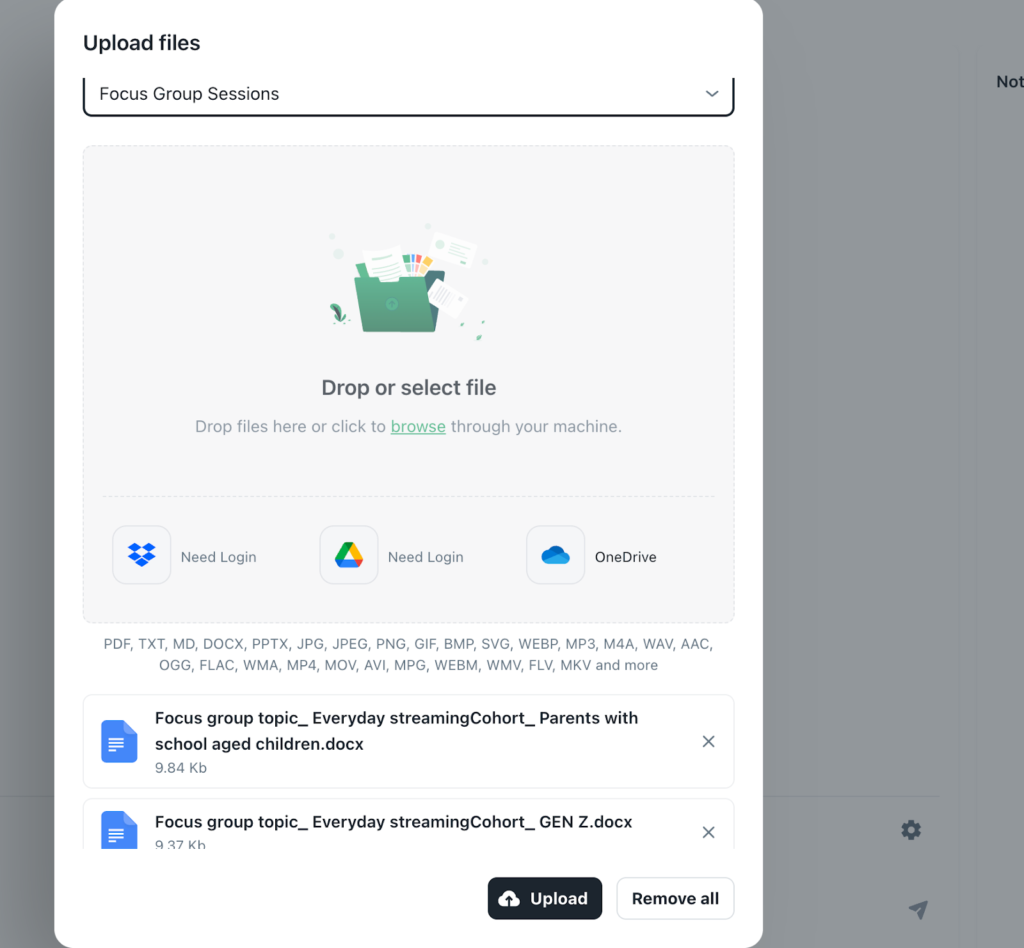
1) Add your recording to the project workspace
Bring audio or video files into Beings by uploading them directly, or by inviting Beings to the session so the material enters the system without passing through external tools. Check that the file appears in the intended project before moving on.
2)N Generate the transcript inside the secure workspace
Beings creates the transcript automatically once the recording enters the project, and the file remains in the secure environment throughout the process. Researchers can download the transcript for review if needed. Check speaker turns and names before moving into the next stage of analysis.

3) Use Aida to analyse recordings
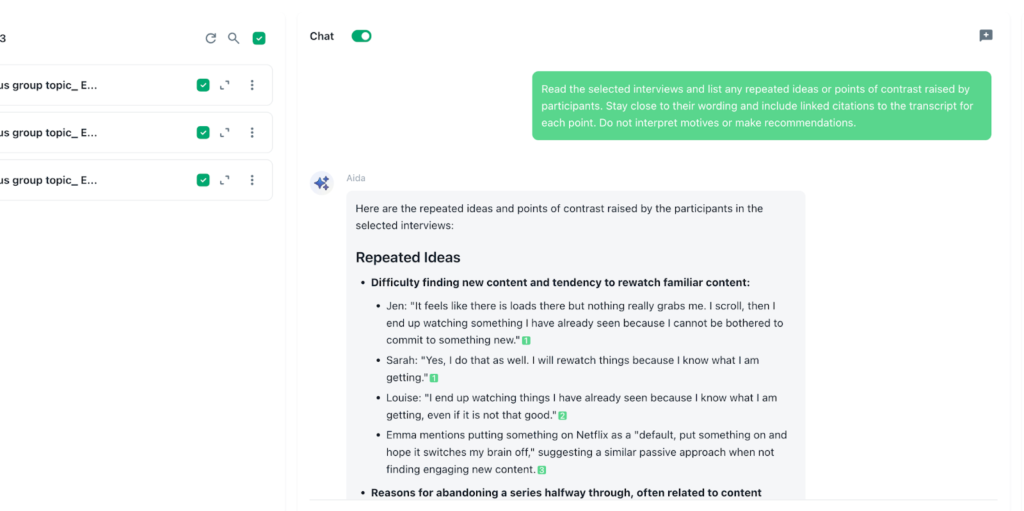
Select one recording or a group of recordings in the project so the analysis stays inside the correct space. Using conversational analysis, ask Aida for early patterns, repeated ideas or points of contrast across the selected interviews. Aida will surface suggestions with linked citations from the transcripts, and you can use these to guide your first round of interpretation while keeping full control over which directions to develop.
4) Build insights and organise the material
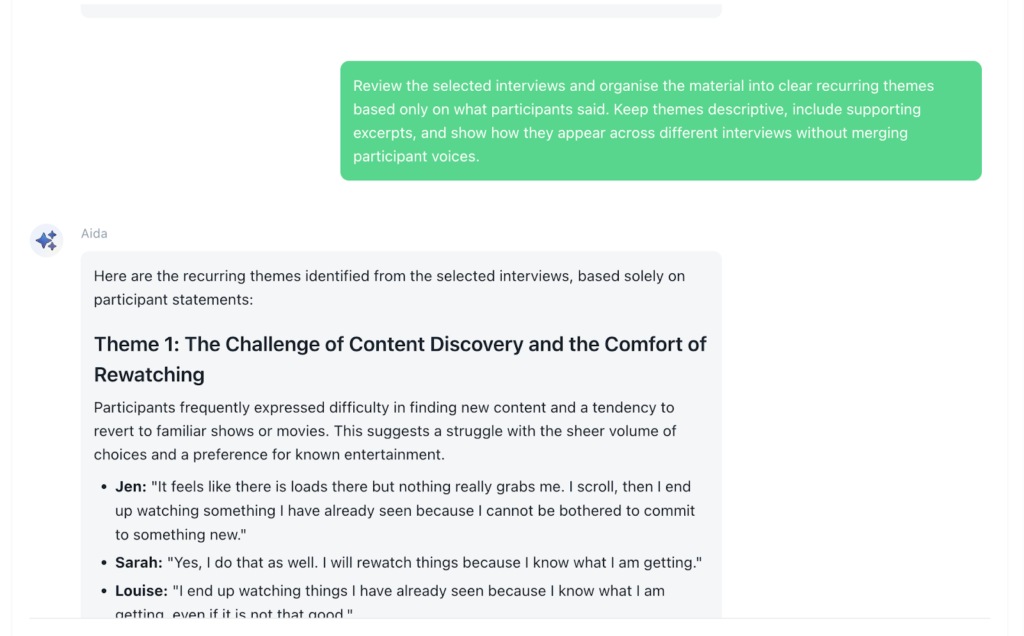
Aida applies internal codes within the system to organise interview material and keep analytic decisions contained within the secure workspace. This removes the need for hands-on coding by structuring the material automatically.
5) Move into early interpretation
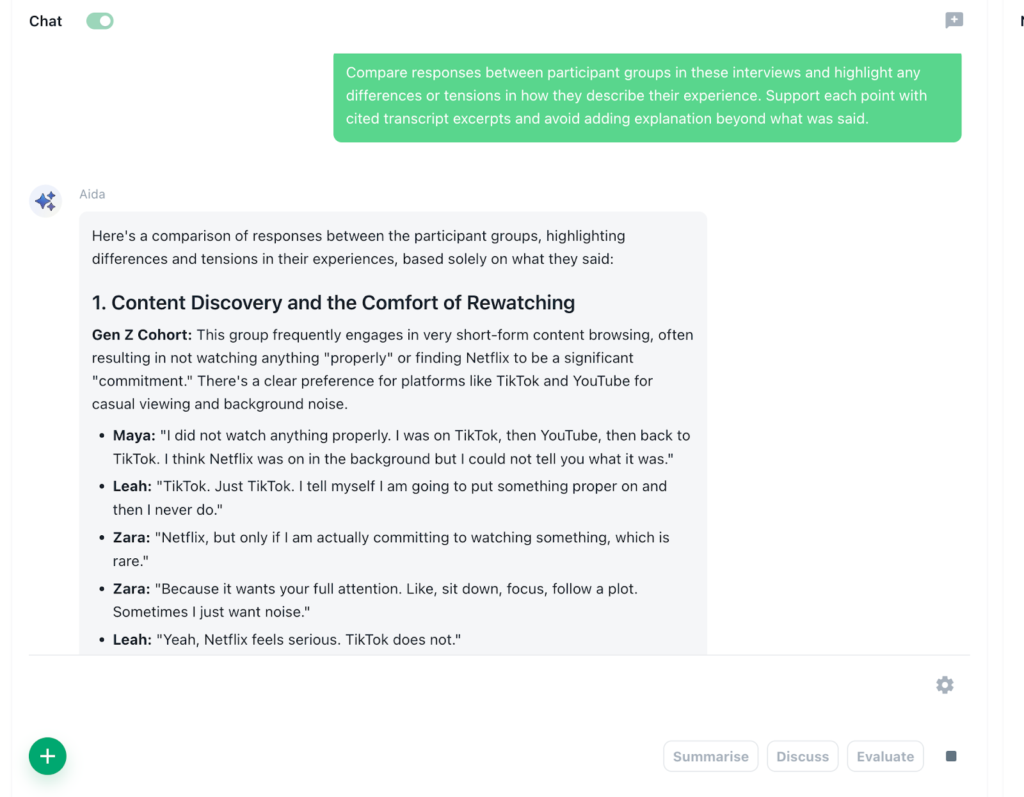
Ask Aida to surface differences between participant groups, highlight tensions in customer statements or bring together citations that support early themes, all whilst keeping the information secure. Review each suggestion carefully and develop the directions that align with the aims of the customer research, maintaining human judgement throughout so the interpretation stays accurate and grounded in the source material.
FAQs on secure customer research transcription
How long are recordings and transcripts stored in Beings?
Recordings and transcripts stay inside the project level repository under the organisation’s retention settings, and nothing is stored outside the encrypted workspace. The user can choose how long they store their recordings. If they decide to delete files then they are soft-deleted and removed from the system within 28 days.
Does Beings send customer recordings to any public AI models?
No. All processing takes place inside the private environment, and customer material is not sent to public models or used for generic training.
Who can access recordings and transcripts inside a project?
Access is controlled by the organisation’s project permissions. Only approved team members or invited clients can view or work with material stored in the project.
Can recordings be uploaded manually instead of inviting Beings to the session?
Yes. Recordings can be uploaded directly into the project, and both routes keep the material inside the secure environment.
Is the transcription process aligned with GDPR and similar requirements?
Yes. Beings is aligned with GDPR, SOC II and HIPAA expectations, and the full transcription workflow remains inside a controlled, auditable environment.
Start a Secure Transcription Workflow Inside Beings
Securely transcribe customer interviews without relying on tools that offer limited visibility or unclear retention by creating a freemium Beings account. The recording, transcript and early analysis will stay organised and secure, giving you a workflow that shows how to transcribe customer research securely inside a controlled environment.