
Can you do qualitative research without coding? For researchers with long-term experience in qualitative work, analysis without coding can initially feel at odds with established practice. Coding became the standard gateway to analysis, with line-by-line tagging, codebooks, and specialist software often used as signals that the work was rigorous and complete.
With AI in the frame, traditional, manual coding is no longer needed to surface and link themes across qualitative research. AI tools like Beings can surface patterns and themes across qualitative data automatically, freeing researchers to spend their time engaging with meaning and judgement rather than manual coding.
Why coding became the default in qualitative research
Coding became the default because it offered a practical way to manage growing volumes of qualitative data. It created a shared structure for analysis and an auditable trail that could be taught to others, while also simplifying the way that the data could be reviewed and defended. It allowed researchers a way to use simple steps to create consistency and accountability.
Even in the 2010s, researchers were already questioning whether qualitative analysis truly depended on first-level coding. A 2013 discussion on ResearchGate shows experienced qualitative researchers agreeing that interpretation is unavoidable, but that formal, line-by-line coding is not a requirement of every qualitative method. Much of the disagreement centred on how coding was defined, rather than on whether analysis itself depended on it.
Qualitative software reinforced this approach by centering analysis around codes, codebooks, and hierarchies. Over time, that workflow shaped how qualitative analysis was taught and practised. Coding shifted from being one useful tool among many to feeling like the entry point to analysis itself.
That shift was practical rather than theoretical. Coding offered a way to cope with scale, complexity, and documentation at a time when few alternatives existed. The underlying goal, making sense of meaning in context, never changed. Coding has often been treated as necessary for qualitative research and data analysis, but it is a convention rather than a methodological requirement.
How qualitative analysis works without manual coding or traditional software
Qualitative analysis without manual coding starts from the same place as any other qualitative project. Researchers still collect interviews, notes, workshop outputs, open text responses, or transcripts. What changes is how the structure is introduced.
Instead of breaking data into segments and tagging each one by hand, AI-supported qualitative analysis examines the full dataset as a whole. Patterns in language, recurring ideas, and points of divergence are surfaced automatically across all responses.
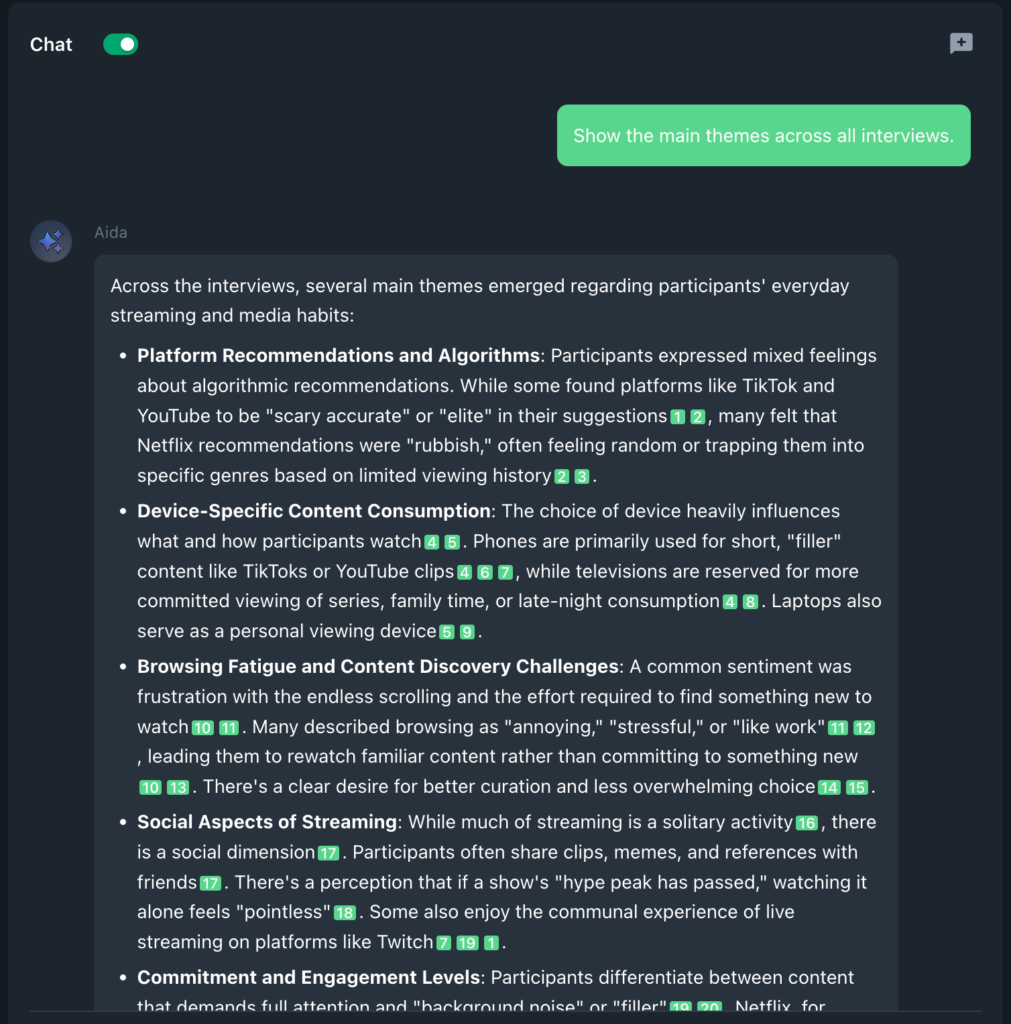
This removes the need to decide upfront what should be coded and how, making it possible to carry out thematic analysis without traditional qualitative software or manual coding workflows. The analytical structure still exists, but it is handled automatically rather than created line by line by the researcher.
One of the benefits of using an AI tool like Beings is that outside assumptions or prior narratives do not influence the codes it surfaces. Aida works on a Ground Truth principle, restricting her analysis strictly to your uploaded Project Corpus. She does not pull in patterns, language, or expectations from the wider internet or other datasets, so what appears in the output reflects what participants actually said, rather than external bias layered on top.
This is how Beings approaches qualitative analysis. Material is organised automatically through internal classification, without requiring researchers to apply visible code tags or manage codebooks. Coding still takes place, but under the hood, with researchers engaging through summaries, theme exploration, and evidence extraction rather than manual labelling.
The analytical work becomes more direct. Researchers review surfaced themes, test them against the original data, and refine their interpretation based on what the material actually shows. If formal coding is required for reporting or client purposes, Beings can surface provisional coding tags based on patterns across the dataset, which researchers can then adapt using their own judgement. If you want to see how those codes have been formed, you can ask Aida to surface them directly.
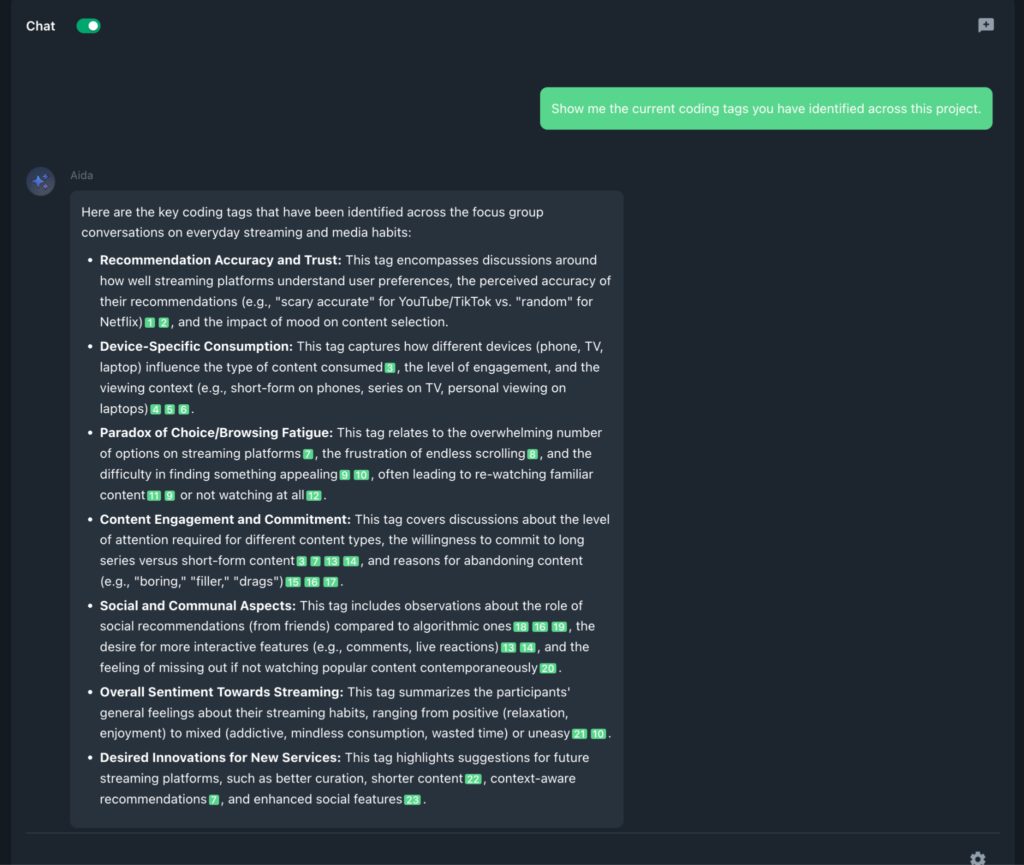
For example, you can prompt Aida to list the current codes she is using, show how they relate to one another, or explain what evidence sits underneath each theme. This makes the coding logic visible without requiring you to manually tag transcripts or maintain a separate codebook, while still allowing you to question, refine, or reinterpret the structure as a researcher.
Traditional qualitative software was designed to help researchers organise text at scale. When that organisation happens automatically, software no longer dictates the method. It supports the researcher in moving from material to meaning without forcing analysis through a coding-first workflow.
The result is a qualitative analysis process that remains disciplined and transparent, but spends far less time on mechanical preparation and far more time on interpretation and decision making.
What changes without manual coding, and what stays the same?
What changes is where time and effort are spent.
Researchers no longer need to manually code transcripts line by line, maintain codebooks, or reorganise data repeatedly as ideas evolve. The early work of surfacing patterns happens automatically, which shortens the path from raw material to analysis and reduces the administrative load that often slows qualitative projects down.
What stays the same is responsibility.
Researchers remain accountable for interpretation, judgement, and explanation. They still need to decide what matters, how themes relate to the research question, and how conclusions are supported by the data. Reflexivity does not disappear, and neither does the need to make analytical reasoning clear to others.
The standards of qualitative research do not change. Transparency, coherence, and depth still matter. What changes is that those standards are met without requiring researchers to spend large amounts of time on mechanical tasks that no longer need to be done by hand.
Can you do qualitative research without coding?
Yes. Qualitative research does not require manual, line-by-line coding in order to be rigorous or credible. What it requires is a clear and defensible path from data to insight. Coding has often been used to demonstrate that path, but it is not the only way to get there.
Interpretation remains central. Researchers still need to engage deeply with the data, decide what matters, and explain how conclusions were reached. What has changed is how the groundwork for that interpretation is done.
AI now handles the early work of surfacing patterns and themes across qualitative data, removing the need for researchers to organise material through coding before analysis can begin. This allows qualitative research to start where it always has the most value, at the point of meaning, judgement, and understanding.
Qualitative research without coding is not a relaxation of standards but reflects a shift in workflow, where structure is supported automatically and intellectual effort is spent on analysis rather than administration.
If you want to explore this approach in practice, you can try it directly in Beings for free by uploading a transcript or recording and working with themes and evidence, without manual coding.