Tools and processes that use artificial intelligence (AI) are now helping qualitative researchers to generate insights that can be shared directly with clients, far faster than previous manual workflows allowed.
Turning raw research data into clear, meaningful data has historically been one of the most demanding stages of any qualitative research project. Researchers often faced long recordings, dense transcripts and trying to follow viewpoints that shifted in small but important ways.
Thankfully, AI, and specifically Beings, has come on so much to support much of that difficult, time-consuming work. This development means that researchers can now work with AI-powered research insights in a way that lightens the early load while keeping interpretation firmly in human hands. The key to using AI to find insights, the parts of the research that make all the difference, is a skill that needs to be developed, much like the skills of any researcher have been over time.
In this guide, we take a look at how AI supports insight generation, how it fits into the existing research workflow and how Beings can help teams uncover what really matters through Aida, its co-intelligent partner.
Why Insight Generation Is Harder Than It Looks
Even with strong fieldwork, focus groups and plenty of interviews to hand, raw qualitative data rarely reveals its best takeaways right away. Group discussions and interviews are filled with subtle cues, unfinished thoughts, short reactions, and comments that make more sense when viewed as a whole, alongside other sessions, rather than in isolation. Keeping pace with all of this can make it harder to produce data-driven insights that feel confident and grounded.
Researchers juggle hours of conversation from multiple participants, each bringing their own viewpoints, experiences and language style. Key points often appear across multiple interviews rather than in a single location. Small shifts in tone can alter the meaning of a comment and points of tension may only reveal themselves when compared with other sessions. This work calls for structure, precision and having enough headspace to recognise the connections that are not always obvious on a first pass.
This is hard to do when you’re manually sifting through hours of data. AI can support this process by bringing order to large volumes of text, video and notes, so researchers can work from a clearer starting point.
How AI Helps Researchers Move From Raw Data to Insight
Using AI tools, researchers can upload one, or multiple, research transcripts. Once uploaded, they can ask the AI chatbot interface to reveal key themes from the transcripts, providing a useful starting point for uncovering deep insight. Often, researchers will find that AI uncovers key themes from the same trajectory they were already on. This reinforcement helps ensure researchers are working from a place of data, rather than letting any human biases get in the way. AI is further support the generation of research insights in these key ways:
- Uncover key themes – AI can quickly compare key themes across multiple hours of research, which would take researchers days, or even weeks, to compare manually.
- Create direct source citations – Once a key theme is developed, either by AI or human researcher, AI can find direct quotes and timestamps to evidence the key theme. Linking directly to that instance within the raw source data.
- Generate research insights across cohorts – To uncover deeper insight researchers can ask AI to look for themes or patterns across different cohorts. For example, comparing whether the same viewpoint was found in senior stakeholders vs junior stakeholders, or whether the views of older research participants differentiated from those in younger cohorts.
This forms the basis of research analysis automation, helping researchers move from raw data to clearer understanding without losing detail.
Most researchers, AI or not, already work through a form of sensemaking, where ideas are compared, linked and questioned until a clearer picture forms. AI’s strength lies in giving researchers a better starting point. All the collective data is easier to move through when themes, patterns and recurring language are surfaced early, especially when those threads appear across interviews that don’t look connected at first glance. AI can group loosely related points so they are easier to revisit with a more discerning researcher’s eye, this helps researchers to spend time on interpretation rather than endlessly scanning for structure and patterns.
The key here is revisiting. Using AI removes the grind that comes with dealing with volume, allowing researchers to come back to the material with more attention and a fresher head. When teams are handling large studies, or a mix of communication styles, this lift is more noticeable and ensures that the later stages of the work are sharper and less convoluted as people have the space to think.
In Beings, Aida is built around this core principle. It is an AI tool for qualitative research that helps to organise, make sense of, and find insights in the raw material as well as sensecheck themes, pattern recognition and connected insight.
How to Use Beings To Support Research Insight Generation
Beings is built specifically for qualitative researchers, not for generic meeting capture. This section walks through how Beings’ AI engine (named “Aida”) can support the research workflow in order to generate AI research insights that are grounded in evidence.
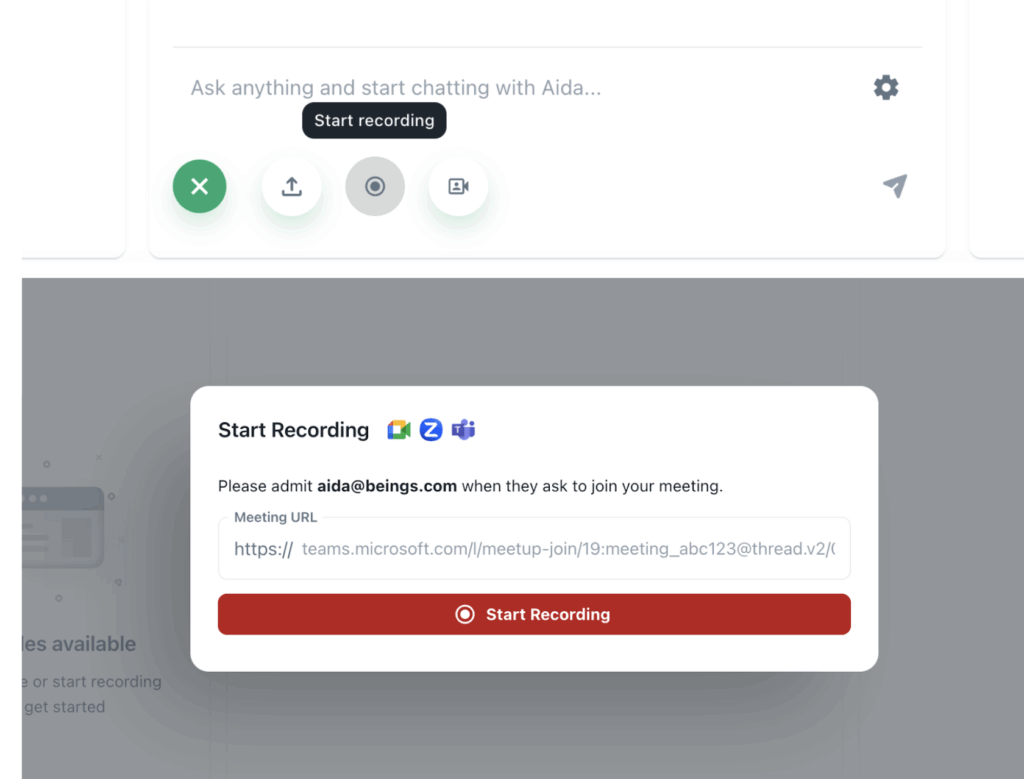
Step 1: Add Aida to the research session
You can invite Aida directly to research interviews or focus groups. Alternatively, you can upload recordings after the event. Aida records the session and places the file in the project workspace so everything stays with the rest of your research material.
Step 2: Turn transcripts into analysis-ready material
Once a session is complete or uploaded, Aida generates an automated transcript with speaker labels and time stamps, stored alongside your documents, notes, briefing materials and any other media.
Step 3: Use Aida to code and analyse your data
Aida begins by coding the material you add to the project, reviewing transcripts, notes and other documents to identify repeated ideas, concepts and areas of focus. This early coding helps Aida form a contextual understanding of what was said across the whole project, rather than treating each interview or document as a separate piece. It gives researchers a clearer foundation for the analysis that follows.
Step 4: Uncover themes and patterns
Using the inbuilt “chat” function, researchers can converse with Aida to highlight early themes, show where ideas cluster and help researchers understand how views differ across groups or cohorts. This gives researchers a clear base to work from as they move into deeper interpretation.
Step 5: Let Aida support your deeper thinking
Researchers can then ask Aida about tensions, repeating viewpoints, emotional notes or anything that seemed to influence or shift opinion. Aida then links responses back to the transcript so that researchers can check the moment in context. This keeps the interpretation grounded in source data and reduces the need to jump between long recordings.
Step 6: Build narratives inside your project
Once patterns begin to emerge and settle, researchers can shape clear narratives backed by evidence, compare across groups and create deliverable insights that trace directly back to the data. Aida can work within a single project knowledge base, which helps the story stay coherent.
How to Use Aida to Deepen Insight
Once the early themes begin to take shape, Aida can then be used as a way to test thinking, strengthen ideas and explore how well the patterns hold across the project.
This part of the workflow moves beyond preparation and into the interpretation phase, where researchers start making decisions about what matters and why.
Aida can help to sense-check early impressions, explore whether a theme is widespread or more isolated and understand how viewpoints differ across participants or groups. Because everything in the project is connected, researchers can move through the material easily.
Once researchers have their initial ideas to explore, they can use prompts in the project to delve deeper into the data. Some ideas of research prompts that can be used include:
- Which ideas appeared consistently across all interviews in this project?
- Show me the comments that helped shape this theme?
- How did different groups respond when asked about this topic?
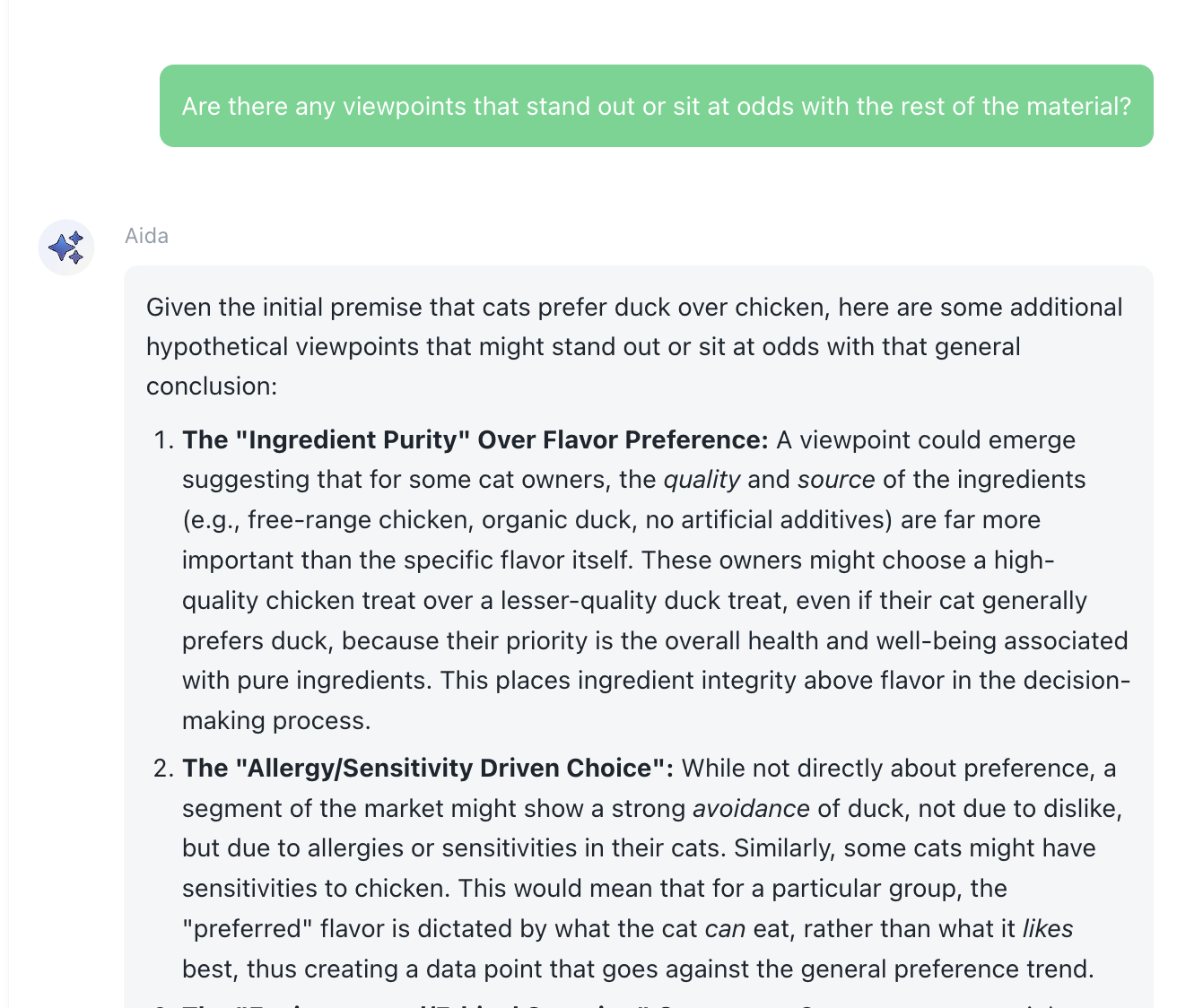
- Are there any viewpoints that stand out or sit at odds with the rest of the material?
- Where did this idea first appear in the project, and how did it develop?
- Which moments reflect uncertainty, hesitation or strong agreement?
- What else tends to come up when participants talk in these moments?
These prompts help researchers check whether early thoughts hold up across the wider project. They also allow teams to keep sight of the source data while moving steadily into interpretation, without sifting through recordings or manually through transcripts. Beings supports this flow by linking responses back to the underlying material so researchers can review each moment in context and decide which lines of thinking are worth taking forward.
Start Generating Clearer Research Insights Today
Insight still depends on the decisions researchers make, the questions they ask and the judgements that they bring to the material. AI supports this work by reducing the volume of those early tasks, allowing researchers to get to the core of the work faster and with a clearer head. It does not, however, remove the interpretation element. This must remain human, even when supported by AI. This balance becomes most useful when projects are large, time is tight or several groups need to be compared at speed.
Beings has been designed for these moments. By keeping every session, transcript, document and note in a single place, and by connecting this data directly to Aida’s analysis, researchers can move steadily from raw material to evidence-backed insight while retaining context throughout. It gives researchers a single workspace to record, review, code and dig into a project with more confidence and less administrative effort.
If you want to see how Aida and Beings can support your next study, you can create an account for free. The workflow is simple, and you can begin exploring your material straight away.