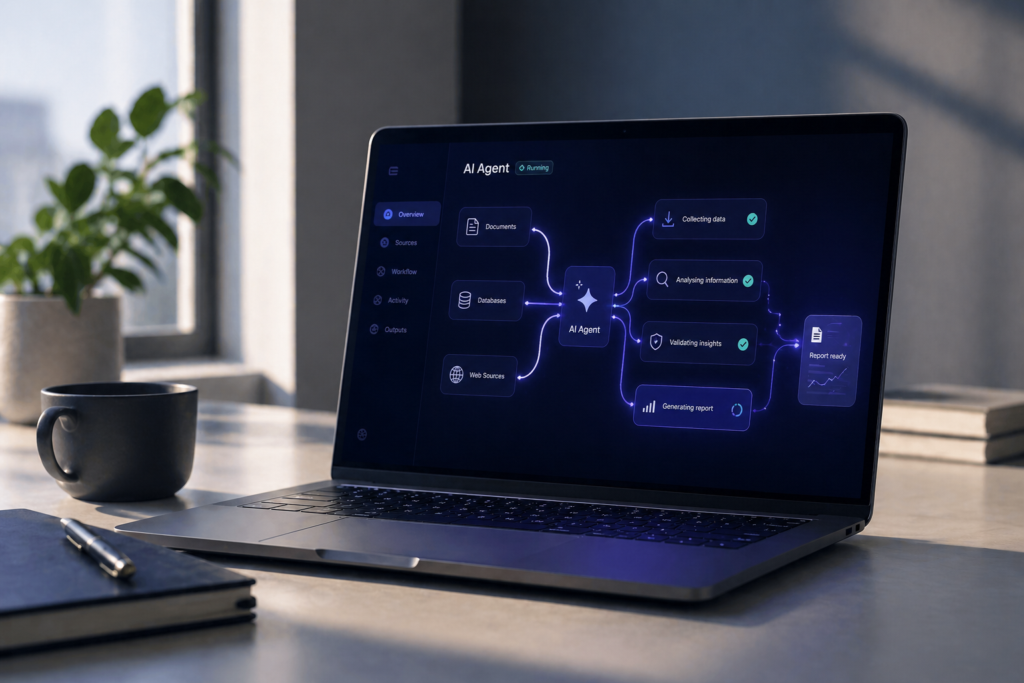
Most people are already familiar with conversational AI. Tools like ChatGPT, Claude, or Gemini respond to a prompt, generate an answer, and wait for the next instruction. Interaction is driven by the user, and the system does not act unless it is asked to.
AI agents operate differently. Instead of reacting to a single prompt, they are designed to carry out a task, or a set of tasks, independently. That might involve breaking a problem down into steps, deciding what to look at next, or moving through a workflow, and making decisions, without needing constant input at every stage.
In research and data reporting, an AI agent helps to create a full workflow, without requiring monitoring or prompts to move through next steps.
AI agents can also work collaboratively: creating an ecosystem where there’s an individual agent for each workflow step. One agent might handle data ingestion, another focuses on analysis, and another prepares outputs or reports.
Working together within the same workflow, passing information between each other, rather than relying on a single thread of conversation.
For research teams, this turns AI from a tool you dip in and out of into something that can support the full lifecycle of analysis and reporting.
Top use cases for AI agents in research and data reporting
At Beings we’re working on pilot projects with customers across sectors such as Finance, Government Policy and Pharmaceuticals, turning deep team insight into AI agents that can work through steps efficiently and collaboratively.
Below are six of the most practical use cases we’re seeing where AI agents are becoming incredibly useful in research and data reporting workflows.
1. Multi-step information retrieval
Conversational AI can interpret documents and retrieve answers to questions quickly. You can upload a file, ask questions about it, and get a clear response.
The limit of conversational AI is that this happens in a single step. The model answers based on what it has in front of it, without checking whether the answer holds up across other sources, or whether further action is needed.
Instead of stopping at the first answer, an AI agent can be configured to search across multiple documents, compare findings between sources, check external data like a website or database, and take action based on what it finds.
For example, you might ask an agent to verify whether a business is still operating. Rather than returning a single answer, it can check your uploaded dataset, cross-reference that against a live website, and then update your records if the status has changed. If the information is unclear, it can continue searching, or flag an entry for review.
This kind of multi-step process reduces the need to manually stitch together checks across different tools or sources. It also improves confidence in the output. The answer comes from a full sequence of checks that reflect how a human would approach the task manually.
This is particularly useful in research and data reporting, where accuracy depends on comparing sources and validating claims as new information becomes available.
2. Automated literature reviews
Most AI tools can search within their own training data or retrieve results from the internet, but this usually happens in a linear way.
AI agents can take this further by turning literature reviews into a structured, multi-step process that runs with less manual input.
Instead of stopping at a list of sources, an agent can break a research question into multiple search queries and search across academic databases, journals, and reports. From there, it filters and ranks sources for relevance, analyses the selected papers in detail, and compiles the findings into a structured research summary with themes, gaps, and recurring arguments surfaced.
This mirrors how a human researcher would approach a literature review, but compresses it into a much shorter timeframe. Some AI systems built specifically for literature reviews can already scan large volumes of academic material, narrow it down to the most relevant papers, and generate summaries with traceable references.
The key difference between conversational AI and an agent here is that the agent can run in the background. The researcher does not need to manually search, read, and extract from each source. The agent handles those steps and returns an output already organised and ready for review.
For particularly active areas of study, this becomes especially useful. Agents can revisit the task, pull in newly published materials, and update the output over time, rather than treating the review as a single exercise. The researcher can focus on interpreting what the body of evidence is saying, instead of spending time gathering and condensing the information.
3. Data collection & aggregation
AI agents can continuously collect data from APIs, databases, spreadsheets, and web sources, and bring it together in a single view.
With conversational AI, this process is manual. You request the data, copy it across, update your files, and repeat when new information is needed. The output captures a single moment in time, and every refresh needs a person to drive it.
An AI agent removes that friction. They can be set up to run in the background, sourcing new data as it becomes available and updating your dataset or report automatically.
For example, imagine you need to understand how regulation changes in your industry, and keep an internal Wiki that’s always up-to-date with the latest legislation.
An agent might track external sources, validate across internal systems, and combine everything into a single dataset that stays up to date without constant input. Reports update automatically as the underlying information changes, rather than being rebuilt each time.
That cuts the risk of relying on outdated information and removes repetitive manual work.
4. Automated data cleaning
AI agents can detect missing values, duplicates, and anomalies before analysis begins.
Conversational AI requires you to upload, ask what needs cleaning, and provide manual input each time. An agent can run those checks automatically, applying consistent rules across the dataset.
For example, an agent can scan a CSV file, standardise formats, flag or fix inconsistencies, and remove duplicates without repeated prompts. It can also revisit the dataset as new data is added, keeping everything aligned over time rather than treating cleaning as a one-off step. The result is a dataset that stays reliable as it grows, with less effort at later stages of analysis.
5. Report generation
AI agents can convert data into structured, standardised reports or dashboards without having to pull everything together manually each time.
Reporting is often one of the most repetitive parts of research and data work. The same sources get reviewed, the same structure is followed, and the same updates get made, with new data replacing old.
An AI agent can manage that process as an ongoing task, pulling data from multiple sources, applying a set format, and generating reports on a set schedule without needing to be prompted.
An agent might produce a weekly customer pain point report by analysing data from CRM systems and customer support tools, compiling the findings into something ready to share. As new data comes in, the report updates automatically, rather than being built from scratch each time.
Reporting becomes consistent, with much less manual effort. Teams can track how things change over time in granular detail, without adding new steps to the workflow.
6. Multi-Agent research workflows
AI agents do not need to work in isolation. They can operate together within the same workflow, handling different parts of the process and passing information between each other.
A concrete example for a research team tracking customer churn might be an agentic workflow that looks like this:
- Agent one pulls data from the CRM, including support tickets and survey responses.
- Agent two analyses that data to identify recurring reasons for churn, flagging patterns like pricing concerns or onboarding issues.
- Agent three scans competitor websites and social listening tools to see how similar problems are being positioned in the market.
- Agent four pulls everything into a weekly report, combining internal data with external context, highlighting key themes, shifts over time, and where competitors may be responding differently.
This turns what would usually be a series of disconnected tasks into a joined-up workflow, where each stage builds on the one before.
Beings: helping you to create AI agents for your most-used research workflows
At Beings we’re helping teams to replace manual, repetitive workflows with smart, customised AI agents that handle the heavy lifting. For support creating your own custom AI workflows, you can email us to request a pilot project at aida@beings.com.